Showing posts with label actually about sports. Show all posts

Wednesday, June 22, 2011

Cycling: S^3.2

Yes, that's right. Bicycles have been part of the modern Olympics since the very beginning, even though bicycles themselves weren't very old by the time 1896 rlled around. For goodness sakes, the first practical pneumatic tire wasn't invented until 1888!

What do you think their tires were made of?

Nowadays, the cycles are engineered to perfection, the exact tilt of the velodrome is calculated to within incredible specification, and there's nary a penny-farthing to be found.
One of the biggest changes in the sport came in 1984, when women were finally able to compete in cycling events.


Anna Meares, after setting a world record in the Women's 500 meters.

Tuesday, June 21, 2011

Athletics: S^3.1

Think with me back to 1896 for just a moment. Utah became a U.S. State, the Philippine Revolution erupted, and, most importantly, the first modern Olympiad took place in Athens, Greece.

On April 6, 1896, the first race was run by the first Olympians the world had seen for more than a millennium. 15 men lined up (not all at once now, the concept of heats is not new) to run 100 meters.

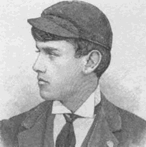
Thomas Burke won with a time of 12.0 seconds.

Thomas Burke probably didn't run in this little hat.

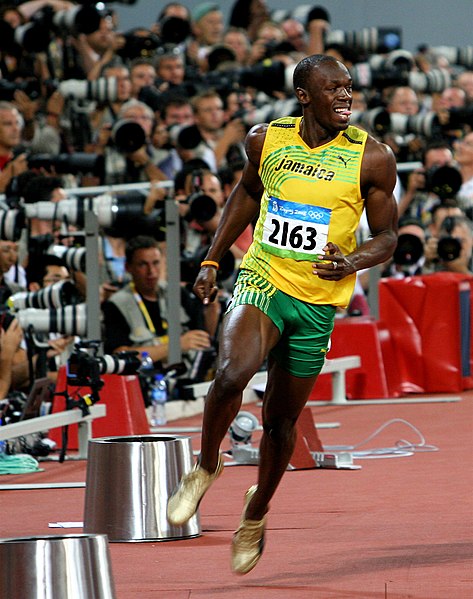
On August 16, 2008 in Beijing, China, Usain Bolt ran the same race in 9.72 seconds.

Usain Bolt celebrates his victory, sans little hat.

In those scant 2.28 seconds lies over a century of feet hitting pavement, discus throwing, and javelins. And sweat. Quite a bit of sweat.

Athletics as an Olympic discipline is also known as Track and Field. It has consisted of 52 different events for men over the years, including Tug of War,* as well as hurdles, the marathon, shot put, javelin, and racewalking.

There are honestly too many events involved to give each one a fair shake. They are all very different from each other, and each has its own set of stars and strategies. What works in an 800m race might not work in a 200m race. It's so important to hold that baton correctly during a relay. Long jumping is distinct from pole vaulting, which is in turn distinct from the high jump. And don't even get me started on the shot put.

Instead of failing at describing them all, I'll just say that I view athletics as an especially beautiful Olympic event, because, for the most part, humans are equally matched for it. Running and throwing are things that are basically innate within us, and it doesn't matter whether or not, for instance, Jamaica has enough snow or funding for a bobsled team. A kid from Kenya who is so inclined can run really, really fast just as well as a kid from America. And they could be beaten by a kid from Argentina, or Azerbaijan, or anywhere else in the world. 

(As an aside, in 1908 Great Britain brought 126 athletes to the Athletics competition, or roughly 42 times more athletes than Austria or Bohemia brought that year. Granted, London was the host in 1908, but still.)

Athletics is one of the few sports in which almost every country can and does participate. And that, my friends, is awesome.

Here is my favorite example of people being awesome:


(If that made you cry, I'm sorry. But not that sorry.)


*Thank you, Wikipedia, for this amazing tidbit:
The events contested have varied widely. From 1900 to 1920, tug of war was considered to be part of the Olympic athletics programme, although the sports of tug of war and athletics are now considered distinct.[1]
Also, please note: we have discussed this before

Further reading:

Wikipedia like WOW.

Monday, June 20, 2011

The Big Five

Beginning today, we here at Mount Olympics will be featuring something I like to call the Summer Sports Spectacular.

Sports.

You may have noticed that we're not, generally speaking, the sportiest bunch. After all, we get way more worked up about Canadian superheroesDick Ebersol's sweater (his glorious, glorious sweater), and, let's be real for a second, Quatchi, than I ever get about wrestling. Or water polo. Or marathons. 

Well, all that is about to change.

This week we will cover the sports I'm calling The Big Five. These are sports that have been present at every single modern Olympics in the history of ever. These are sports that Pierre de Coubertin himself sanctioned at the first Olympics, way back in 1896.

Won't you join us for nonstop coverage of:

Athletics!

Cycling!

Fencing!

...and...

Swimming!

I can feel the excitement radiating from here. Join us, then, tomorrow, for more exciting coverage of the world of Athletics. Until then...


Yes, that is Wenlock and Mandeville. Yes, I drew them myself. 
Yes, I'm maybe a little more proud than is strictly necessary. 
What of it?

Wednesday, February 2, 2011

Awesome photo alert!!

SUPERHERO STATUS: CONFIRMED

This photo is brought to you courtesy of the new Mount Olympics twitter account (OMG I KNOW)! It features Ele Opeloge of Samoa being a complete and total phenomenon while competing in the women's +75kg group A weightlifting event on August 16, 2008 in Beijing, China. 

Photo credit: Jed Jacobsohn, Getty Images, retrieved off the IOC's Flikr.

Thursday, February 18, 2010

Olympic Overload!

Oh man, there is so much Olympics going on, I can't even say.

First off, we have an amazing entry into the field of sports journalism by Timothy Eagan, about Canada broadly and his fake ID specifically and national identity and all that good stuff.

And then we have some malfunctioning zambonis, that meant an intermission of about an hour for no good reason... but it gave us more time to ogle the speed skaters.

There's a good story in here somewhere about gender bias in the Olympics and why women aren't allowed to ski jump (spoiler alert: it's because they would beat all the men) but a Canadian curler could be competing while five months pregnant (awesome!!).

I've got to write more in-depth about the NBC coverage and the internet and twitter and Olympics Triple Play (and Dick Ebersol and Dick Ebersol's sweater) and why something like this can totally happen in this day and age:


Aaaaaand that's not even getting started on the incredible tales of athletic prowess, speed, precision, and artistry that are going on. So yes! I am going to get back to watching Shaun White beat the pants off everyone. In the meantime, here:

Enjoy your mind trip as you watch Quatchi watch himself WATCH YOU.

Tuesday, February 16, 2010

Tragedy

I realize this is old news, but news it is: the Olympic Movement suffered one of its greatest tragedies right before the Opening Ceremonies when Georgian luge athlete Nodar Kumaritashvili lost control of his sled, smashed into a pillar, and died while taking a training run on Whistler's luge track.

My urge is to make light of even the most serious of incidents, but I will try and refrain. He will be remembered as a great athlete from a little country, a young man who never reached his full potential.


Goodbye, Nodar. I hope you thought you were flying.


Monday, September 28, 2009

UPDATE!

Apparently, I can't spell. Caster Semenya's name is spelled Semenya, not Semenaya. I'm not going to change it, however, because apparently some other folks can't spell as well. And honestly, I want folks who can't spell to land here rather than the website that calls Semenya horrifying names. I won't link to that article, I'm actually sorry that I clicked there and gave them any traffic whatsoever.

Instead, here's an only slightly offensive story comparing Usain Bolt's treatment to Caster Semenya's.

And, callooh callay, the officials' behavior is being investigated. What should really be investigated is our collective behavior, however. We are the monsters.

Tuesday, September 15, 2009

Caster Semayana and Gender in Sports

That's a pretty pretentious title for what is mostly going to be a bucket o' links post. As soon as this controversy arose, we here at Mount Olympics began composing a brilliant post about gender, sex, and its role in sporting competition. The problem? We got distracted by shiny, shiny things and then... other people said it better. So this post will have three parts!

Part 1: Bucket o' links!


John Green is amazing.

Lauren McMillan is similarly amazing.
IAAF urges caution, which would be great, except that somebody kind of leaked the results.
"Results of the gender investigation aside, Caster Semenya’s humanity has already been sacrificed to Western culture’s desperate, frightened effort to maintain the fiction of binary, fixed gender."
Semayana gets a makeover for You magazine. Gah.
Time offers an incredible slideshow showcasing Semayana's triumphs and strength.
The science behind the scandal.
Idiocy of sex testing!
Semayana withdraws from race in South Africa.

God, it's just so monstrous.

Part 2:

This is not the first time that an athlete's gender has come into question. Here's the thing: sometimes people do try and cheat. I'll have to try to have more GoogleFu later, but I'm pretty sure there were a couple of instances of men entering women's competitions just to win. I'm also pretty sure they don't always win.

Here's the story of another athlete who had to deal with this gender testing: Santhi Soundarajan. And her advice? Don't let them win. You already won.


And don't let anyone stop you.

Friday, August 28, 2009

Defining athalons

All you ever wanted to know about athlons, One through Ten!

Athlon
: Not a sporting event, but apparently a sporting goods company. And now you know.

Of course, it is also a term derived from athalon, from the Latin for "competition." It's the same word from which we get "athlete" today. (One Wikipedia page (aquathlon, for future reference) seems to think that it really means "wrestling," but Wikipedia spelled Latin "latten," so, you know.)

Biathlon: Usually refers to a winter sport combining cross country skiing and shooting. Apparently, the sport can trace its roots to exercises that promoted Norwegian national defense. Of course it does. The summer version is cross country running and shooting, and the "modern biathlon" refers to running and swimming.

Triathlon: Swimming, running, biking. Not necessarily in that order. (I actually don't know. Maybe you do have to do it in that order?) Apparently we have only the French to blame, or maybe San Diego. Wikipedia does not give me a solid answer. The Ironman is specifically a 2.4 mile swim, a 112 mile bike course, and then, uh, if you're not tired yet, a marathon. Holy crap.

Quadrathlon: Swimming, kayaking, cycling, running. Uh. What? Apparently, sometimes roller skating is also involved. I'm dubious. Here's a quote, straight from Wikipedia: "Quadrathlon adds flatwater kayaking to the sport of triathlon to create a balanced test of fitness." Right. Not to be confused with the Tetrathlon, which involves riding a mount over a course of obstacles, shooting an air pistol, cross country running, and swimming.

Pentathlon: MYTHOLOGY ALERT! The pentathlon was an ancient Greek sport, featured in the Ancient Olympics (man I love those). The mythical hero Perseus accidentally killed a dude (though not the Gorgon, that was a different time) with a discus while competing in the pentathlon, fulfilling an oracle's prophesy.

Mouth guards, people! They matter.

Originally (as in "Ancient Greece" originally), the pentathlon was part of military training. Aristotle once wrote "a body capable of enduring all efforts, either of the racecourse or of bodily strength...This is why the athletes in the pentathlon are most beautiful." (Right, Aristotle.)In 1906, the pentathlon made its modern Olympic debut as a conglomeration of five track and field events, but it was discontinued in 1984 and replaced by the heptathlon because it kept getting confused with the "modern pentathlon."

The modern pentathlon was introduced in the 1912 Olympics. Returning to the -athlon's military training roots, the sport was invented by Pierre de Coubertin, founder and first president of the IOC. He wanted to test skills required by a soldier (so this was sort of like the Norwegians, but with less snow). According to Wikipeda, he was "working from the template of a 19th century soldier fighting behind enemy lines," and came up with epee fencing, pistol shooting, freestyle swimming, show jumping on horseback, and a cross country run. It basically has all the elements of an amazing action flick. The sport was male dominated until Sydney 2000, female athletes got a chance to show off their James Bond meets The Great Escape skills. Sexy awesome!

Sextathlon: Either a dirty joke or a Frenchman named Ygor swimming, biking, running (in scandalous shorts), then skiing (in the middle of a city?), golfing, and playing a game of hockey. Perhaps the proper term is Hexathlon, which is referred to in this exerpt from a blog about the game of bridge: "The Modern Hexathlon combines traditional disciplines of track and field (javelin throw, long jump and marathon) with aquatics (200-meter backstroke, 400-meter freestyle and high diving)... The Modern Hexathlon also relates well to bridge, as these six problems illustrate." Then there are six bridge problems, like those things that show up near Dear Abby in the paper. The internet really is killing the newspaper! In the most boring way possible!

Heptathlon: Seven events! One day! Here's what's in store: 100m hurdles, high jump, shot put, 200 m race, long jump, javelin throw, 800 m race. Wow. It also involves the academic decathlon, because scoring has an equation that looks like you might need better than basic math skills. Seriously, there are variables and constants.

Octathlon: Occasionally, in Tahiti, you try to host a decathlon. But the pole vault equipment doesn't arrive on time, and you have to abandon the high jump and the pole vault entirely. So you have to change the name of the event entirely, because you can't call it a decathlon with only eight events. The Tahition Olympic Committee isn't happy about it, but then they realize that they're in Tahiti and pretty okay with life, all things told.

Nonathlon: Something involving an indoor rowing machine. We're getting farther away from international athletic competition here, people.

Decathlon: Finally! Ten events! Amazing! They are spread over two days and encompass the 100 m, the long jump, the shot put, the high jump, the 400 m, 110 m hurdles, the discus, the pole vault, the javelin, and the 1500 m. Basically, if you can run it or chuck it, you do.

There we have it, one through ten. Only four of these events are in the Olympics and a couple aren't really, you know, real. But hey! Any Athlon is a good Athlon, right? Speaking of which, if you absolutely want more...

Other athlons (also known as "I forgot how to count in Greek and so did much extraneous googling"):

Duathlon: Woah, confusing! Though it sounds like it should be back down there with biathlon in the 2 slot, actually has three (or maybe two?) events. Most commonly, the term refers to running, then biking, then running again. Duathlon is also used for the winter sport of skiing cross country (traditionally) and then changing your skis to ski cross country some more, only this time with the skate skis! Exciting times on those nordic tracks.

Aquathlon: Underwater wrestling. Maybe could also mean swimming followed by running, but that wouldn't involve (supposedly sexy) underwater wrestling, now would it? But wait, now I am plagued by questions! How does that even work? Do the athletes float? Are they weighted down? Do they have oxygen? Are they allowed to go up for breaths? Is Wikipedia lying to me again?

Quintathlon: The best definition I can find comes from a website touting the wonders of Alaska. They advertise the "Barefoot in the Park Quintathlon: Swim, bike, shoot, kayak and run, then picnic in the park." Picnic makes it six events, though. I wonder if the organizers thought about THAT.

Tuesday, August 25, 2009

Unfortunately, Sledge Hockey does not mean Hockey with Sledge Hammers

Let's talk about the Paralympics!

We already gave some brief mention to the Paralympics, but they really deserve more love. Unfortunately, most folks don't mention the Paralympics in discussions about the Olympics, when really, these athletes are at least as deserving of heaps of glory. (Not just because the International Paralympics Committee's website is better designed than the IOC's flashy, unnavigable mess.)

I mean, have you SEEN the movie Murderball?? Holy shit, those athletes are AWESOME.

OMG MURDERBALL

Since the Winter Games are coming upon us, we'll focus on the four Winter Paralympic Sports.

Alpine Skiing:
In both the Paralympics and the Olympics, Alpine Skiing means skiing down a hill that would certainly make me wet myself. Athletes in the Paralympics compete in Downhill, Super-G, Super Combined, the Giant Slalom, and the Slalom (the normal, everyday Slalom, apparently). These events all take place in the Olympics as well, and in both cases there are competitions for men and women. In the Paralympics there are also specific categories for standing skiers, sitting skiers, and visually impaired skiers.

Are there special rules? You bet! "Skiers on one ski are not allowed to use the free limb in contact with the snow to gain speed or to keep balance."

Visually impaired skiers "must wear blacked-out goggles during the competition." They use the same equipment as Olympic skiers (other than the blacked out goggles, of course), and have guides who can communicate only by voice and radio communication.

Oh man. Hard core.


Nordic Ski:
Paralympic Nordic Skiing has two categories: Biathlon and Cross-Country Skiing. Again, it's broken down into standing, sitting, and visually impaired. In contrast with the Paralympic Downhill Skiers, standing Nordic Skiers use the same equipment as able-bodied skiers-- no nifty mini ski-sticks for them! (Nifty mini ski-sticks is not what they are called, but I believe deeply that by coming up with that phrase I have begun my career as a Paralympic Equipment Marketing Consultant. Look for the ad campaign.) Sit skiers use a sit-ski-- really. It's a ski... where you sit. Visually impaired skiiers again have a guide that can guide them through voice or radio.

Nordic Sit Skier: Better than you at everything.

The Biathlon is made up of two events: skiing and shooting. In the Paralympics, all shooters must fire their guns from a prone position. Also? This little exciting nugget from the Vancouver 2010 Paralympics web page: "Visually impaired skiers use an acoustic system for shooting that uses differing tones as the rifle is aimed toward the bull’s eye." OH MAN acoustic aiming!

Wheelchair Curling:
Someday soon we will have a post about Curling, affectionately known as Chess on Ice (no really), because I love it so. Who doesn't love Chess on Ice? You must have a heart made from a stone (and not granite, for that is what a curling stone is made of) to not love Chess on Ice. For now, this is all you need to know: Wheelchair Curling differs in two ways from Non-Wheelchair Curling. First, the athletes are in wheelchairs (I KNOW CRAZY RIGHT?). Second, no sweeping. In the case of Wheelchair Curling, delivering the stone is where the magic happens.

Ice Sledge Hockey:
This is actually one of the first sports adapted such that folks without full use of their legs could continue playing it. It predates wheelchair basketball and murderball. The international rules are essentially the same as Ice Skate Hockey and modeled specifically from the Canadian rules. The equipment is slightly different, of course. The skates have been replaced with a sledge and athletes use two hockey sticks. One is used mainly for propelling along the ice, and the puck handling stick is shorter, straight, and has picks on the end for even more propelling action.

Unfortunately, no sledge hammers in Sledge Hockey.

Also? Sledge hockey brawls. You'd better believe they exist.

***
Occasionally, people get weird about the Paralympics. They're not as popular as the Olympics, they don't happen at the same time, and some folks say they don't serve any purpose. Either the athletes should compete against "real" athletes or they should stay home. If you ever hear anyone talking like that, here's what to do. Tell them about the 2014 British Paralympic hopefuls. Here are three guys, all veterans of either Iraq or Afghanistan, all maimed in the line of duty. What are they doing now? Serving their country with four skis between them.

I'll admit it, I'm a sucker for a story about overcoming adversity with the Olympic Spirit (TM). And that's how it's done, folks. Paralympians deserve nothing more and nothing less than our respect as serious athletes and competitors. We'll be keeping an eye on the Paralympics as well as the Olympics here on Mount Olympics. I hope you'll do the same.


Image sources:
http://www.cbsnews.com/stories/2007/10/21/sunday/main3389200.shtml
http://www.paralympic.org/release/Winter_Sports/Alpine_Skiing/Rules/index.html
Vancouver 2010 Paralympic website
http://blogs.smarter.com/sports/2009/03/02/hockey-video-a-different-kind-of-hockey-brawl/


Thursday, June 12, 2008

Badass South Africans

What is the Olympics about, really? Is it about all the nations in the world coming together as a peaceful community in the name of healthy competition? Is it about blatant and shameless capitalist consumerism? Is it about running swifter, reaching higher, and being stronger?

If you listen to American coverage of the Games, it is about one thing and one thing only: the amazingly heart-wrenching story of triumph over adversity. And this year the gold medal goes unequivocally to team South Africa.

First we have Oscar Pistorius. He is a world-class runner, having broken a world record in the 400 meters and set many other South African records in other sprinting events. Known as the fastest man on no legs, Pistorius wins able-bodied races despite losing both legs at an early age.

Some have questioned his speed an agility, chalking up his wins to his disability. They contend that his carbon-fiber prostheses give him an unfair advantage. Citing data that suggested his prosthetic legs used less energy than the calves of other runners, the International Association of Athletics Federation ruled in January that he would be ineligible for the Olympics. But in May, the Court of Arbitration for Sport ruled that there was insufficient evidence to prevent Pistorius from qualifying for the able-bodied Olympics.

He has not done so yet-- he has until June 30. I think he can. He's the Blade Runner, after all.


As if that weren't enough for the amazingly awesome South African team, swimmer Natalie du Toit has qualified for both the Olympics and the Paralympics-- the first athlete ever to compete in both events. (Pistorius may be the second, if he qualifies for the Olympics.) She is also missing a leg, but does not use a prosthesis for swimming-- making her less controversial than her fellow countryman. But honestly? No less awesome.


Diving off the starting block. Awesomely.

Man, South Africa, you are so cool right now. You have the most badass athletes of all the athletes so far. Good job.